Absolution
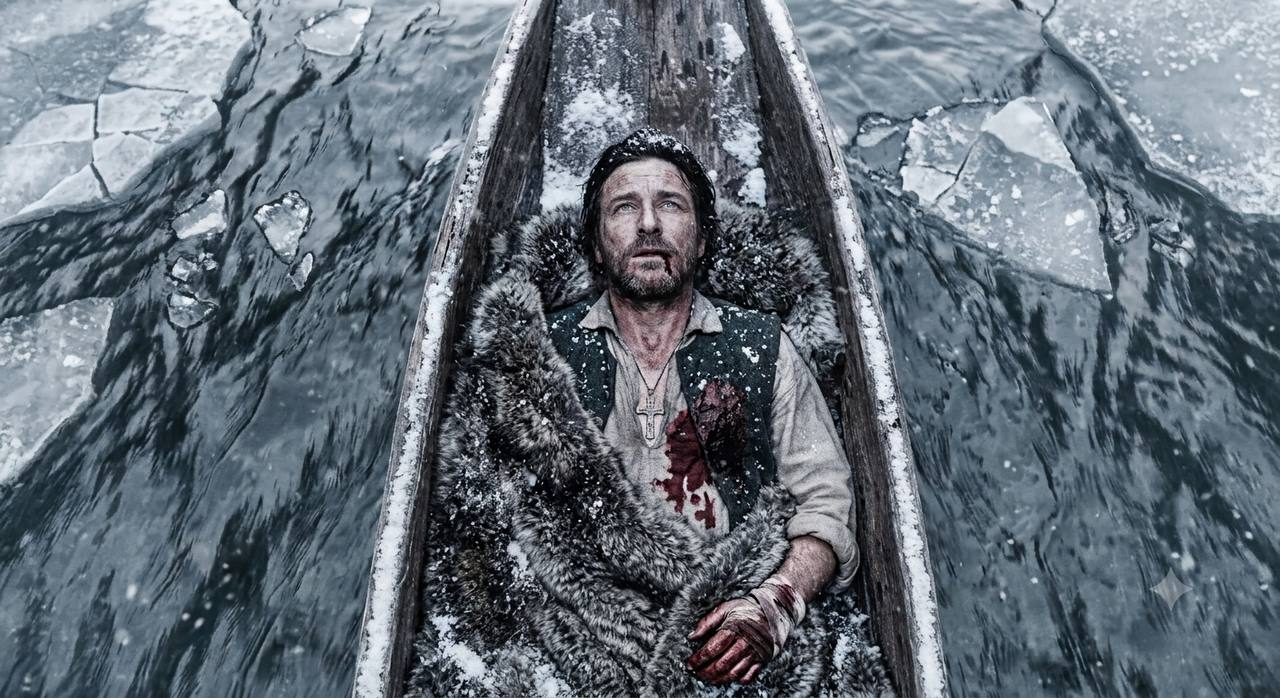
The canoe was empty when the light first touched it, resting where the current had left it against a bend in the reeds. Then her hands found him. Careful, quick, trembling with an urgency they tried not to show. She lowered him into it the way one lowers something already breaking, and he felt the world tilt and slide without understanding why, drifting somewhere beneath consciousness, catching only fragments, the cold wood at his back, the smell of river, the copper taste on his lips that he couldn’t place, a shape bent over him that might have been mercy or might have been grief. He tried to lift his arm toward it, some reflex older than thought, but his body no longer answered him the way it once had, and the arm fell back before it had risen at all. She pulled a fur blanket to his chest and pressed it there a moment longer than she needed to.
Then the voices. Sharp, clipped, carrying the particular urgency of men calling out orders rather than conversation, cutting through fog that had, until then, held the morning in silence. Through the haze, shapes began to break loose from the trees, indistinct shadows quickening toward them. She saw them before he did. Her hands changed.
The gentleness became force. She shoved the canoe out into the current with a sound torn out of her, half effort and half grief, and it was already moving before she finished speaking.
“God be with you.”
That was all. He did not see her go. He never saw her at all.
The river carried him. Snow began somewhere above him, sparse at first, a few flakes finding his face like they were testing whether he’d notice. He hadn’t, not yet. His mind was elsewhere, in the places minds go when the body has already started letting go.
His hand found the cross at his chest, fingers closing around it the way they had a thousand times before, and he looked up, into the grey unbroken sky, before he finally spoke.
“God, I’ve seen it all,” he said, though there was no one to hear it but the water. “Neighbors turning on neighbors. Men naming the innocent to save themselves. Men in God’s own house, passing judgment they had no right to pass.” He paused, the question already forming, the one he’d been avoiding. “Have I any right to pass judgment on them, Lord, when I have committed the same sins in my own heart?”
Then the memory rose the way certain memories do, uninvited and total. “Lord, I stood by. I watched while an innocent woman was brought to the stake and burned.” His breath shook. “That was me, Lord. Your own child.” Tears came now, finally, unhidden. “I weep for her now. I failed to protect her. I know you weep with me.”
“All I have left, Lord,” he said, “is being here. With you.”
The wind moved through the reeds along the bank. The river kept its steady sound beneath him. And there, in that quiet, something in him went still in a different way than before. His breathing changed first, slowed, then caught, then released, like a held door finally letting go of its latch.
He drew a breath in deep, deeper than his wound should have allowed, and with it came everything around him, the cold, the falling snow, the grey unbroken sky, the sound of water that had carried him since before he could remember why. And it came to him, plainly, without argument, that all of it, every flake, every current, every breath of wind through bare branches, had been made with him in mind. Not accident, not indifference. Made for him, specifically, the way a father builds a fire not for warmth in general but for the child he knows will be cold.
“You never saw me the way I saw myself,” he said, quiet and sure. “I was my own accuser, Lord. I counted every sin twice and refused every mercy you gave me even once. You forgave me long ago. I was the one who wouldn’t let it stand.”
“I know it was you, Lord,” he said, steadier now. “Your law, written on my heart, guided me all my life, a path I couldn’t see until it revealed itself in the end, leading me to this moment.”
“I finally did what was right, Lord.” A breath. “And I have no regrets.”
The snow had gathered on the fur blanket, on his chest, on his stilled hands. His eyes found the sky one last time, wide and grey and endless, and he did not look away from it as he had looked away from so much.
“Lord, please take me home.” A pause, not of hesitation now, but of arrival. “I’m ready now, Lord.”
His eyes closed. The snow kept falling, unhurried, covering him the way it covers everything eventually, gently, completely. And somewhere beneath that white, so quiet it might have gone unnoticed by anyone but God, he breathed his last breath.
He had found peace. Peace with himself, at last, after a lifetime spent withholding it. And peace with God, who had been waiting for him to arrive there all along.
Then only stillness. Stillness that finally faded into the light he’d spent his whole life looking for.